The “Greifswald” Children’s Gymnastics Apparatus in Occupational Therapy
The utility and relevance of the “Greifswald” children’s gymnastics apparatus within the pediatric field of occupational therapy practice
by Tom Salomon Amon (B.Sc. in Occupational Therapy)
The “Greifswald” Children’s Gymnastics Apparatus
A therapeutic movement system for pediatric occupational therapy
Children explore their world through movement. Every action, every game, and every everyday demand relies on the ability to perceive one’s own body, coordinate it, and use it in a purposeful way (Zimmer, 2025).
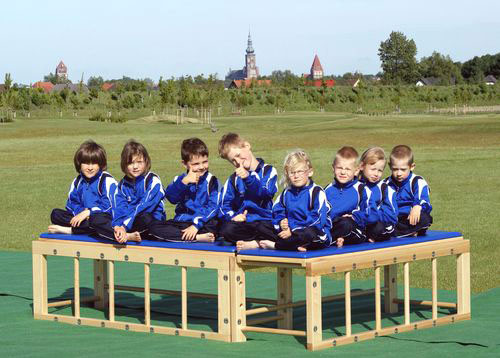
This is precisely where the “Greifswald” children’s exercise equipment comes in: it serves as a versatile, modular movement system that specifically supports children’s sensorimotor development and can be integrated into occupational therapy practice to address a wide range of needs (Ayres, 2016).
Occupation as the foundation for occupational therapy-related functional capacity
Pediatric occupational therapy aims to strengthen and support children’s ability to engage in everyday activities—at kindergarten, at school, and during leisure time (Scheepers et al., 2006).
Key prerequisites for this are:
- a stable posture,
- well-developed sensorimotor skills and sensory integration,
- a coherent body image (emotional),
- balance and coordination, and
- motor planning
The Greifswald children’s gymnastics apparatus makes it possible to foster the foundations of children’s play-based activity in a way that is both versatile and scientifically sound (Salomon, 2005).
One device – diverse applications in occupational therapy
The modular design of the children’s exercise equipment allows for a wide range of movement patterns that are precisely aligned with occupational therapy objectives:
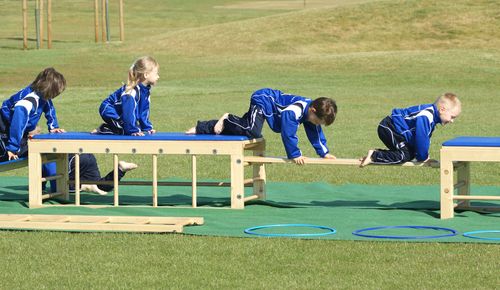
Crawling, Pulling, and Pushing
These forms of movement intensely activate the proprioceptive system, strengthen the core and shoulder musculature, and promote bilateral coordination. They are particularly well-suited for regulating muscle tone, attention, and body awareness.
Relevance to occupational therapy:
- ADHD/ASD
- Sensory processing disorder
- Infantile cerebral palsy
- Developmental delays
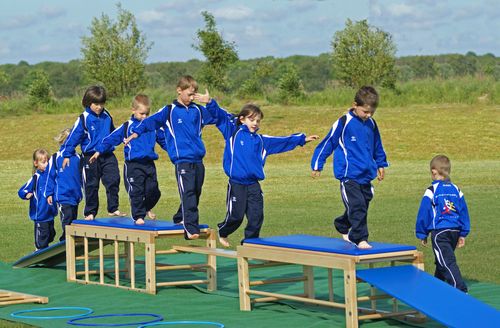
Walking, Balancing, and Climbing
Postural control is developed through the use of varied surfaces, heights, and transitions. Children learn to adjust their balance, plan movements in advance, and navigate new situations with confidence.
Relevance to occupational therapy:
- UEMF / DCD
- poor bodily stability
- secondary instabilities
- early-childhood ataxias
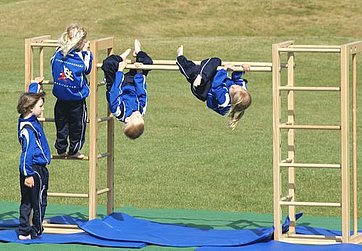
Climbing, hanging, and supporting
These forms of movement foster the relationship between strength and load, motor planning, and self-efficacy. Children come to perceive their bodies as capable and competent—a key emotional factor in therapy.
Relevance to occupational therapy:
- low muscle tone
- low frustration tolerance
- low self-efficacy expectation
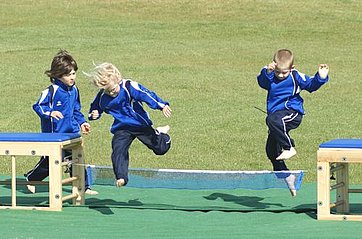
Jumping, rolling, and swinging
Vestibular-based movements support spatial awareness, improve balance reactions, and contribute to emotional regulation. Through methodical progression, the exercises remain controllable and safe.
Relevance to occupational therapy:
- sensory integration disorders
- kinesiophobia
- spatial orientation disorder
Therapeutically sound – methodologically well-conceived
The Greifswald children’s gymnastics apparatus is characterized by a clear methodological structure:
- from a broad to a narrow base of support,
- from the floor to an elevated level, and
- from guided to independent movement
This structure enables occupational therapists to tailor exercises precisely to a child’s developmental stage—as well as their age, weight, and height—and to target specific therapeutic goals.
The "Greifswald" pediatric exercise equipment supports occupational therapists, in particular, through the wide range of variations that a single piece of equipment offers for both individual therapy and small-group sessions.
More than just a piece of gym equipment – a therapeutic tool
In the context of occupational therapy, the "Greifswald" children’s exercise apparatus is not a conventional piece of play or sports equipment, but rather a functional therapy system that:
- employs movement in a goal-oriented manner,
- provides structured support for therapy processes,
- fosters motivation and enjoyment in engaging in activities, and
- facilitates the transfer to everyday life
Thanks to its precisely replicable design, the system can be used for diagnostic testing in pediatrics, providing insight into gross motor and perceptual abilities or deficits.
In this way, KTG offers occupational therapy practices a sustainable, versatile, and scientifically sound addition to their range of therapeutic services.
Our Commitment
With the Greifswald children’s exercise equipment, we provide occupational therapists with a tool that meaningfully integrates movement, development, and therapy—for the benefit of the children and in support of professional therapeutic care.
The equipment is manufactured in and around Greifswald, in collaboration with long-established, family-run local craft businesses. In this process, sustainability and durability are of the utmost importance to us.
Bibliography
Ayres, A. J. (2016). Sensorische Integration verstehen und anwenden: Bausteine der kindlichen Entwicklung. Springer Berlin, Heidelberg. https://doi.org/10.1007/978-3-662-52891-4
Salomon, E. (2005). Das Kinderturngerät Greifswald (KTG). Sportmuseum aktuell, 2005(2-3).
Scheepers, C., Steding-Albrecht, U., & Jehn, P. (2006). Ergotherapie. Vom Behandeln zum Handeln: Lehrbuch für Ausbildung und Praxis. Georg Thieme Verlag KG.
Zimmer, R. (2025). Handbuch Sinneswahrnehmung: Grundlagen einer ganzheitlichen Bildung und Erziehung. Verlag Herder GmbH.